
https://www.insidehighered.com/news/students/diversity/2026/06/10/reaching-young-black-men-creating-sense-belonging#:~:text=Male%20Achievement%20Collaborative.-,Pathways%20to%20Campus,-For%20Black%20men
by Ashley MowreaderResearch shows that Black students are more likely to face disciplinary action in school, which can make them feel less safe and supported. A 2012 survey found that nearly half of Black boys at public schools grades 6 to 12 have been suspended from school at some point.
At the same time, Black students often face academic disadvantages in high school that can limit their college opportunities. They are less likely than their White peers to be recommended by their teachers for advanced coursework, and their schools are less likely even to offer advanced coursework or dual enrollment (completing college classes while in high school) opportunities.
While 15 percent of all high schoolers in the U.S. are Black, only 8 percent participate in dual enrollment, said John Fink, a senior research associate and program lead at Columbia University Teacher’s College Community College Research Center (CCRC). In comparison, white students account for half of the students in dual enrollment, though they comprise 46 percent of all high schoolers.
When Black students do earn college credits in high school, they’re more likely to attend selective universities and to complete a bachelor’s degree in a competitive field like STEM, Fink said. But “the vast majority of school districts have racial and ethnic gaps in dual enrollment participation,” according to CCRC findings.
To provide greater access to dual enrollment and offer a glimpse into the college experience, some HBCUs have embedded charter schools on their campuses.
One example is the Early College School, a public charter middle and high school in Dover, Del., housed at Delaware State University, the state’s only Historically Black University. ECS enrolls up to 625 students, predominantly of color, in grades 7 to 12 and allows them to earn up to 60 credits at DSU and graduate with an associate degree.
On paper, ECS operates like all other charter schools in Delaware: both the middle and high school are open access, and students are chosen through a lottery. But walking on campus reveals just how distinctive it is.
The middle school is connected to a DSU student center and the high school is nearly indistinguishable from other campus buildings. Pictures of Black heroes and celebrities decorate the hallways alongside a list of their accomplishments. ECS students dine in a DSU cafeteria and spend time at the student union; those enrolled in college courses trek independently to various academic buildings.
One of them, Darius Rainey, a senior from Smyrna, Del., has dreams of working in cybersecurity and IT. He knew college would be a part of his plan (in part influenced by his dad and dad’s friends’ career paths) and he believes ECS’s dual enrollment opportunities have expedited his journey to get there.
“I feel like I’m a lot more prepared for the college classes next year; it definitely put me in the mindset that I needed,” Rainey said. He graduated in May with his associate degree and will start at DSU in the fall.
ECS’s average daily attendance rate is 95 percent, 4 percentage points higher than the national average—and a rarity in any high school post-COVID. Its four-year graduation rate is 95 percent for all students including Black students, 7 percentage points higher than the state average.
Administrators attribute student success to high expectations, strong relationships between students and teachers and Black male mentors in the school.
“Being connected to people who you don’t want to let down in some ways [is important], because I know they’re invested in me, not just as a person, but also in what it is that I want to pursue and accomplish,” said Brooms of Morehouse, an all men’s HBCU in Atlanta.
Scholars, as teachers call ECS students, are reminded early and often that attending college courses is a privilege they earn. Students said they’re pushed to reach the same level of maturity as their college-going peers. In addition to content knowledge, they gain time management and professional communication skills, as well as diligence in respecting school rules.
On a campus tour, students pointed to various buildings and noted exactly which grade levels were allowed to access them. Dorms and parties are off-limits to ECS students; the student union is open to students in college courses, and the on-campus Chick-fil-A is accessible only to college course attendees on good behavior. Administrators stressed they want to give students a taste of college life, predominantly through academics.
Another feature that sets ECS apart from other Delaware charters is its demographics. The students are mostly students of color, and the staff are predominantly Black, with Black men serving as coaches, teachers and counselors.
Nationally, Black men make up only 1.3 percent of public school teachers, despite comprising 6 percent of the total population. Having just one Black teacher is associated with greater educational gains for Black youth.
“When you talk about Black boys in school and higher ed, they have to see themselves and what they can aspire to be,” said Dara Savage, associate principal for Early College School.
But the turnover rate for Black male teachers is high, partly because Black men are often tasked with disciplining Black students, said Kai Maull, one of ECS’s school counselors. “The more of that that happens, you know, the males, they get out. That’s where the burnout comes for them, for us.”
On average, over 60 percent of ECS students enroll at Delaware State after graduation. This year, 64 percent of graduating men will attend DSU in the fall and an additional 15 percent will attend another college or university, Principal Nyia Pritchett said. This past fall, Delaware State’s ECS model expanded to HBCU Early College Prep, a public charter school in Queens, New York, welcoming just over 100 high school freshmen.
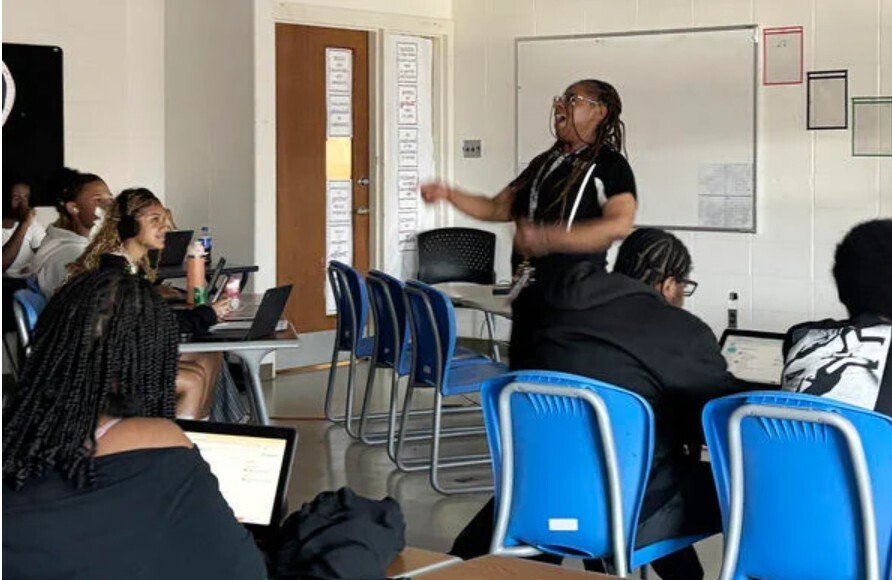
Early College School Included In Article from Inside Higher Ed
June 10, 2026